

This year has been SO exciting so far! We’re incorporating a TON of new routines into Spanish I. One of the new things I’m trying to make sure I include is a daily brain break in Spanish! As we go through class I’ve really upped the level of Spanish being used (trying to hit that 90% time!) and I’m definitely feeling the need for breaks.
There are a TON of great ideas for Spanish Brain Breaks out there, but I actually found it kind of overwhelming. Which ones do I use? How do I remember them all? How do I get organized? I knew I needed something to help me make sure I incorporated them, and I wanted to be purposeful about them.
Click here to check out my post on socially distanced brain breaks!
Brain Break in Spanish Video
Google Slides to Organize my Brain Breaks for Spanish
It’s (probably) no surprise that Google Slides were my solution.
I started a set of Google Slides, one slide per Brain Break. Then, I sat down with my computer and Googled my heart out. I added instructions, visuals, and links on each Slide until I had a decent “bank”.
Then I went to my daily Slides that had my lesson plans and just inserted them where they might be needed. I started with one and did that and a variation for starters. Then I added a few more.
My teammate and I have been really purposeful about which brain breaks we use when. For example, the first week of school was a lot of variations on name games and nice to meet you’s.
This week we did “Chocolate” as a brain break because we had a reading about chocolate! I really wanted them to hear the word in Spanish several times to help them learn how it should sound before we did the reading.

They’re not always something “focused” on what we need. Some of them are just silly, and that’s perfect! Do what works for your classes.
Fun Ways to Level Up Your Brain Break in Spanish
If you’ve been using the same few games every time, it’s time to mix things up. A Brain Break in Spanish doesn’t have to be just a quick stretch or a name game, it can be an experience that connects to what students are learning. One idea is to turn a vocab review into a movement challenge. For example, call out words from your current unit and have students act them out like charades. Not only does it give their brains a break, but they’re also reinforcing key vocabulary without even realizing it.
Another favorite is what I like to call “speed rounds.” Pick a category foods, colors, sports, and have students go around the room naming items in that category in Spanish as quickly as possible. When someone hesitates for more than three seconds, the round ends, and you start a new one. The energy this brings to the room is amazing, and it works beautifully as a Brain Break in Spanish because students are moving, laughing, and thinking fast in the target language.
Take a Brain Break in Spanish
Here are a few of the brain breaks included in the Slides:
- Rock, paper, scissors
- Rock, paper, scissors (feet)
- Rock, paper, scissors (train)
- Rock, paper, scissors (chorus)
- Rock, paper, scissors (evolution)
- Rock, paper, scissors (just 2 people)
- Zip Zap Zoom
- Body Part Race
- Selfie
- Chocolate
- Chocolate (bailando)
- Chocolate (lines)
- Chocolate (faster and faster)
There are more, but I wanted to give you an idea of what to expect in the Slides! It’s really helpful to just be able to open it up and go!
Brain Break in Spanish Google Slides
If this sounds like a strategy that could work for you, here is where you can access the presentation!
I cited sources in the speaker note sections of the Slides. If you’re confused, check out those notes! Lots of them include video or picture examples of how to do things.
A large number of these came from La Maestra Loca! If you’ve never checked out her blog you MUST. It’s amazing and full of ideas, visuals, and videos! SO so helpful.
Keep It Purposeful and Fun
While the point of a Brain Break in Spanish is to relax, that doesn’t mean it can’t reinforce learning. For example, try pairing your break with cultural tidbits. Play a short clip of a popular Spanish song and have students do a quick dance move when they hear a specific word. It’s simple, but it sticks. You can also use visuals—flash a picture of an object and have students shout “¡Me gusta!” or “¡No me gusta!” It’s quick, interactive, and keeps the Spanish flowing.
If you’re organizing your ideas in Google Slides, don’t just list activities. Add pictures, short instructions, and links to videos so you can grab one at a moment’s notice. When a Brain Break in Spanish feels effortless for you, it becomes a natural, fun routine for your students.
What Should I Add to my List of Brain Breaks for Spanish?
It’s week three of school and we’ve got a pretty solid handle on about ten different breaks. I will continue to add more as I go – I know I’ve only scratched the surface of the ideas that are out there!
Do you have any favorite brain break in Spanish that I should add? I’d love to try them out!
If you use these, I’d love to see them in action! Tag me on Instagram @srta_spanish, or on Twitter!
Have fun!
Save this Post for Later!


-
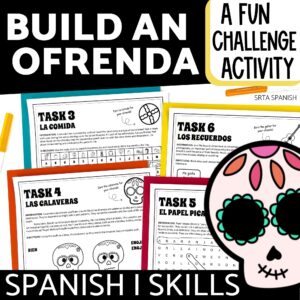
El Día de los Muertos Activities Day of the Dead Escape Room Spanish Lesson Plan
$4.25 Add to cart -
Sale!
Día de los Muertos Activities for Exploring Day of the Dead
Original price was: $12.59.$8.12Current price is: $8.12. Add to cart -
Día de los Muertos Day of the Dead Digital Activities in English
$3.75 Add to cart -
La Familia Spanish Family Tree Vocabulary Activity Reading Comprehension Passage
$5.25 Add to cart
8 Responses
hi sta spanish the links in your google presentation are not working. They are linking me to an error page. Is there anyway you can provided all of these links if you have these available
Gracias, this is going to help me a lot.
I appreciate it.
Julieta
Gracias señorita !
Thank you for sharing!
Thanks for these! So many more to add to my collection. I also have done them in google slides to keep track! I use the slides as a part of my agenda and all of my activities and brain breaks are there.
I did want to comment though that in Spanish “seña” is the noun for a sign, not the command like you have in your slides. If you want to say point in command form you’d say “señala” from the verb “señalar”. 🙂
Oooh thanks! I’ll update that ASAP!
Have you incorporated Jesse and Joy’s “Chocolate song”?
AND, MUCHíSIMAS GRACIAS!