If you are working with middle school or high school Spanish 1 classes, you’re probably going to start off with some basic Spanish introductions & greetings like, “Good morning” or “Good afternoon”, depending on when you have class! Let’s look at Spanish worksheets you can use to review greetings & farewells worksheets in Spanish!

Saludos y Despedidas Spanish Vocabulary List

There are many common Spanish introductions greetings and farewells words or phrases you might choose to include. Here’s just a few I like to make available to my students as we are working. This isn’t something they’ll get all at once, just a few at a time over a series of lessons!
This printable has the Spanish word or phrase and the English translation for students to reference!
Common Spanish Greetings & Farewells Vocabulary:
- ¡Adiós!
- Buenos días.
- Buenas tardes.
- Buenas noches.
- ¡Chao!
- ¿Cómo estás?
- ¿Cómo está usted?
- ¿Cómo te llamas?
- ¿Cómo se llama usted?
- El gusto es mío.
- Estoy bien.
- Hasta luego.
- Hasta pronto.
- Hasta mañana.
- ¡Hola!
- Me llamo ________.
- Mucho gusto.
- Nos vemos.
- ¿Qué tal?
- ¿Y tú?
- ¿Y usted?
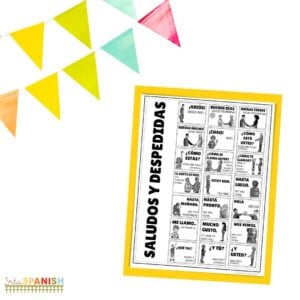
When students are first working, I like to give them a list of the Spanish greetings with the English and Spanish translation to refer to. As your Spanish students grow more comfortable they will refer to the Spanish greetings less and less.
If you’re not too sure about this, check out my blog post on Must Have Posters for why I think it’s great to give your Spanish learners that visual support and reference.

Spanish Introductions Greetings Worksheets
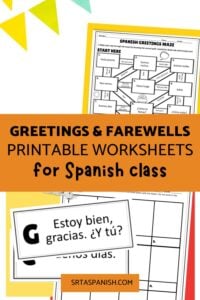
Review greetings in Spanish vocabulary with these puzzles and worksheets! This set of Spanish worksheets includes a word search in Spanish, maze activity, and more to practice in Spanish 1 in a PDF file. Your middle school and high school students will love these interactive worksheets!
Spanish Introductions Greetings Word Search
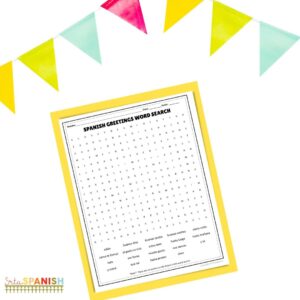
In this printable worksheet, students look at the word bank and find the basic expressions hidden in the mess of letters. Word searches are a great way to get your students thinking about how the words sound in Spanish and connecting spelling patterns in the language. An answer key is included as well!
Maze Printable Worksheet

I love maze games for practicing Spanish vocabulary and grammar! In this lesson idea, students will read the basic Spanish greetings and farewells. Then, they will select the corresponding English greetings and farewells to find their way through the maze. For example, if a box reads, “Buenas noches”, they’ll follow the path that says “Good night”. They’ll repeat that, step by step, until they “escape” from the maze!
When they finish, they extend the activity by using the boxes that were the incorrect answers for some additional practice.

Click here to see 10 ways to play maze games in your World Languages classes!
Spanish Introductions Greetings Color by Numbers
Color by number is a fun way for your students to review! For this particular topic, students will read the basic salutations in Spanish, then choose the English translation in a simple matching activity. Then, on the separate page they will complete the color by number sheet according to the key they created in the matching activity.

Students can complete this activity with the colors in Spanish or in English. You can choose, based on their vocabulary needs!
Grid Puzzle Game
Grid puzzles are a great way to review vocabulary words or phrases. Students use the square pieces and line up Spanish and English translations until they match. You can have them play independently, or with different classmates as partners for review. This pdf file includes 2 difficulty levels, too!
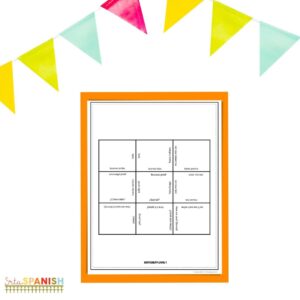
Here are a some activity idea options for using grid puzzles in your classroom:
- Warm Up or Bellringer
- Independent Work
- Partner Work
- Small Groups
- Stations
- Sponge/Fast Finisher Option
Grid puzzles make a great addition to a group of activities for stations as students work to pair the correct answers. Click here to learn more about using grid puzzles in your classroom!

Spanish Introductions Greetings Worksheets
All of the printable worksheets and answer keys from above are available here in one PDF download!

Connect Greetings to Spanish Reading Comprehension Passages
Once your students feel confident with greetings, it’s a great time to tie them into short readings. Using Spanish Reading Comprehension Passages is an easy way to make vocabulary stick in context. Instead of isolating words like “hola” or “buenas tardes,” let students see them in action inside a short dialogue or paragraph. For example, share a passage where two friends meet for the first time and exchange basic introductions. After reading, ask students to highlight every greeting or farewell phrase they notice.
This is a simple step, but it gives meaning to what they’ve learned. Students aren’t just memorizing a list; they’re seeing how real conversations start and end. Plus, those Spanish Reading Comprehension Passages can double as speaking practice. After reading, pair students up and have them recreate the dialogue, then add their own twist. This quick follow-up moves greetings from the page into real-life conversation, which is exactly what we want.
Make Reading Fun and Interactive
If reading feels too passive, turn it into a class challenge. Take one of your Spanish Reading Comprehension Passages, cut it into sections, and turn it into a sequencing game. Students work in groups to put the sentences back in the correct order. While they’re busy figuring out the flow of the dialogue, they’re also reviewing vocabulary and reinforcing comprehension skills.
You can also combine reading with a movement activity. Post parts of a short passage around the classroom and give students a list of questions to answer as they move from one spot to the next. It’s like a gallery walk, but with the added benefit of input-rich practice. Not only are they reading, but they’re connecting vocabulary with context and doing it in a way that feels like play. By sprinkling these Spanish Reading Comprehension Passages into your greetings unit, you keep lessons fresh and purposeful while building a strong foundation for future topics.
Spanish Introductions Greetings Listening Practice Exercises for Beginners
Dictation in Spanish class is a great way to practice listening comprehension and writing skills. You can choose to place an emphasis on spelling if you would like and encourage students to spell as accurately as possible to help them pay close attention to pronunciation.
For dictation, I personally often encourage students to just listen the first time through the sentence, then record it the second or third time through. In this set, students listen to phrases from a sample dialogue and record their short answer. For an extension activity, students can re-order the sentences to put into a logical, short dialogue.
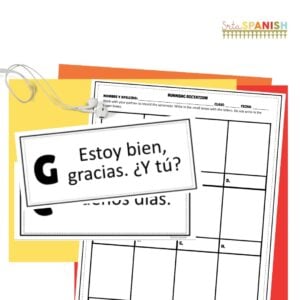
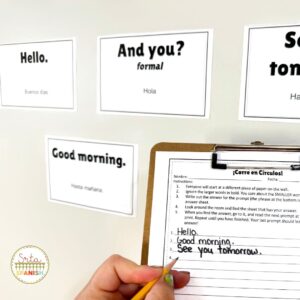
Of course, a good variation on dictation is Running Dictation! It’s a small tweak of classic dictation that has your students up and moving. They work in pairs or in groups of three to read a sentence hung on a wall, memorize it, then repeat it out loud to their partner. Their partner listens and records the sentence that they hear from their partner.
Halfway through the activity, they swap with their partner. This is great not only for listening, but also pronunciation practice as their partner is relying on them to communicate clearly so they can be successful. Learn more about how to set up this activity for your classes here!
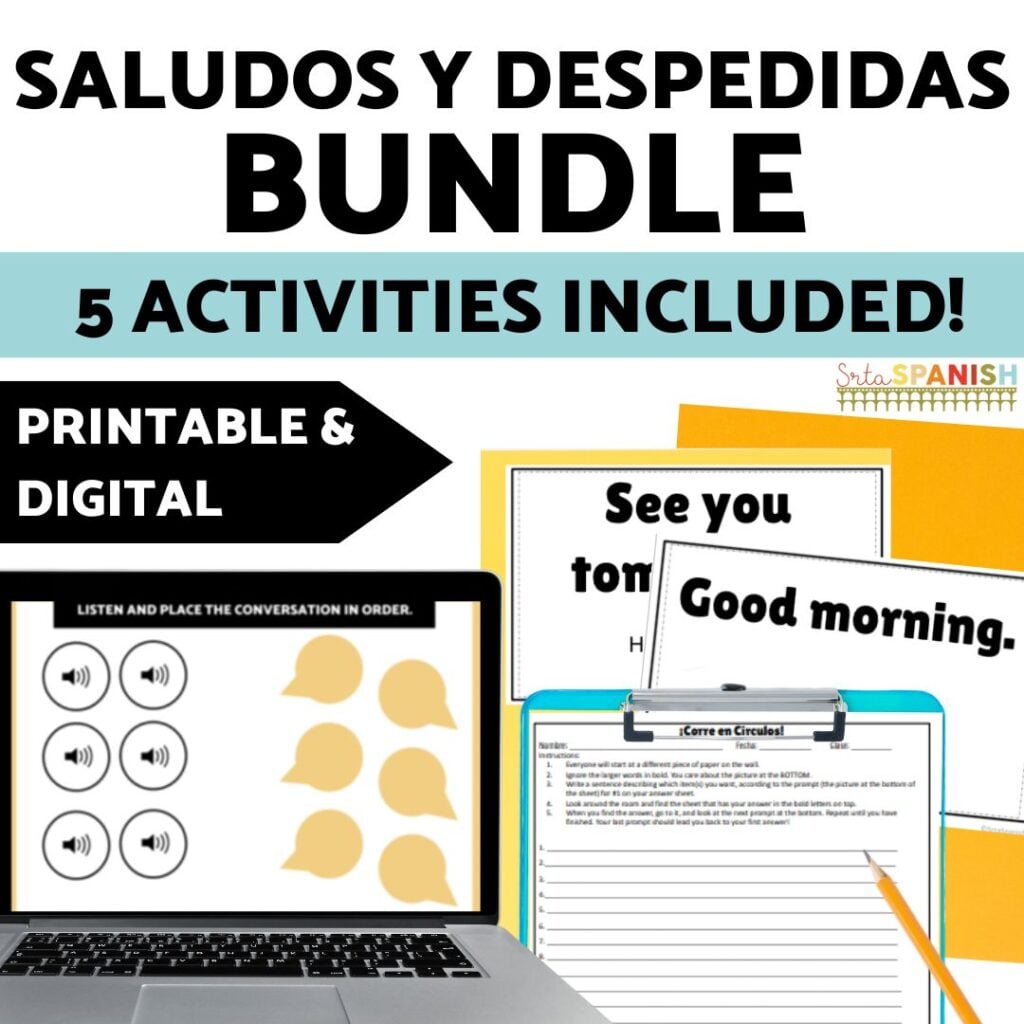
Spanish Introductions Greetings in Spanish Bundle
If you’d like to save yourself time while lesson planning, click here to download these saludos y despedidas Spanish vocabulary activities for your Spanish classes! Activities in this package of resources are included in audio and pdf format so you can download, and use them in your lesson ideas.
More Spanish Activities
If you’re looking for more ideas to help you plan the start of your year, check out these posts!
Here are 15 easy ice breakers and getting to know you activities for the start of the school year!
All set with the first week of school? Let’s look ahead to the whole first month!

Save this post for later!


-
El Día de los Muertos Activities Day of the Dead Escape Room Spanish Lesson Plan
$4.25 Add to cart -
Sale!
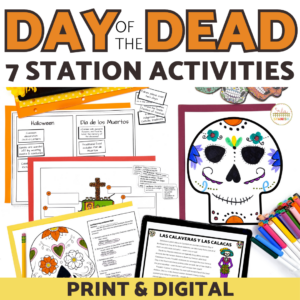
Día de los Muertos Activities for Exploring Day of the Dead
Original price was: $12.59.$8.12Current price is: $8.12. Add to cart -
Día de los Muertos Day of the Dead Digital Activities in English
$3.75 Add to cart -
La Familia Spanish Family Tree Vocabulary Activity Reading Comprehension Passage
$5.25 Add to cart