Are you feeling stuck and overwhelmed? Let’s chat about classroom management in Spanish class and some different perspective shifts to help reduce your stress level, get you in a positive space, and improve your classroom environment!

Watch the Video
Classroom Management in Spanish Class
First let’s talk about factors that our outside of our control, factors that are in our control, our reactions to things, and then some places that we can go to for additional support. We can’t do it all on our own!
I also want to make clear that I wouldn’t say I’m a classroom management expert. This is coming from a place of my own personal experience which means that I might not be speaking to something that you have experienced, or the setting that you are in. I’ve taught levels 1, 2, and middle school exploratory classes.
External Factors that Affect Classroom Management
There are many factors that affect your classroom environment that are outside of your control. Here’s a few:
- school community
- admin support
- guardian involvement
- class sizes
- school schedule (when does the school day start/end? when is lunch scheduled?)
For the first few things on the list I talk about red flags to look out for in my Teacher Interview Prep series. In my opinion, there are some things you really can’t do anything about, other than find another school. For example, if you call for help, and no one answers the phone, there’s not a lot you can do about that lack of support.
If you’re not allowed to send a child out of the classroom, for a walk, to have some space or some quiet, and you’re not allowed to do that, that would be something I would consider an issue in the school environment.
Check out some more environmental flags to keep your eyes out for here:
Class size is another thing I would put under environmental factors outside of your control. You can of course advocate for yourself, and be vocal at school board meetings and in the community, but sometimes things come down to hiring and not having space to put kids during hours in the day.
I’m also going to add that I have left a teaching environment mid-year. I am not an advocate for it as a practice, but I will say there are times where tossing in the towel is absolutely the right answer.
Responding to External Factors
When it comes to the factors outside of your control, I have one big piece of advice for you. That is to have a loud mouth to advocate for yourself and your students, repeatedly.
Even more than repeatedly, I would venture into say aggressively and via email, so there is a paper trail.
After sending an email, put a reminder in your phone. That way, if or when you don’t get a response, you can follow up by simply forwarding your previous email and say, “Hey, I haven’t heard back from you about x, y, or z.” Use your judgment on how pushy you want to be, but if admin is considering something, they can click reply and communicate that to you!
If the thought of being pushy via a paper trail makes you uncomfortable or concerned for your employment, I have a few thoughts for you. First, if you’re in a union state, go for back up. Second, if you’re not in a union state and you are untenured, I can understand that it might make you really afraid to be pushing these boundaries and repeatedly emailing people.
Consider pushing as you feel comfortable, and then evaluate whether or not that school environment is something you would want to stay in long term. Sometimes it’s okay to push, because you’d be happy to move on if push came to shove!
Also, have your students tell their guardians. Sometimes cranky parents can move mountains! If there’s a situation that is negatively affecting the school’s environment, students can bring that home, and then home can start calling or showing up at school board meetings to make a change.
Classroom Management Tips
Seating Arrangements
Now let’s look at things you can control in your classroom! First, let’s talk about classroom set up, specifically how you arrange your desks into rows, groups, or any other arrangements. Now I have an entire post on seating arrangements so I’m not going to go into that TOO far in-depth, but I think you already know how arranging and re-arranging seats can affect your classroom environment.

In short, I would say that every teacher will find their “Goldilocks” arrangement based on the physical space you have, the equipment available, your teaching style, and each batch of students. Yes, sometimes you switch up seating arrangements between class periods, if that’s what it takes!
Classroom Set Up
Along the same lines of classroom seating arrangements, thinking about the decorations and visual supports you have available for your students are a really important piece of classroom management. You might be wondering, “Why on earth are we talking about posters for classroom management?”, but the answer is simple:
Your decor is a part of your classroom environment. The environment in your classroom affects your management and functionality of your classroom.

Check out my blog post here for the essential posters you need to decorate your classroom and support your students!
Classroom Rules
This is the area I tend to feel the most “off” from others: classroom rules and expectations. Before I spell it out, I’m just going to remind you that this is how I run things in my classroom – but that might not work for you, or you might have different opinions, and that’s okay!
I take a very laid back approach to this. I don’t go over rules and expectations on the first day of school, we don’t co-create classroom rules, and I only have classroom rules posted if it’s a school-wide PBIS poster requirement with whatever catchy motto is scrawled across the top. In my classroom, things are generally fine & good unless you cross the line.
There are times where as a whole class we will talk about exact and specific expectations, like for story telling or story asking days, running dictation, Corre en Círculos – activities that might take a turn for the particularly wild if we don’t have very clear lines and boundaries, so I like to review those with students.
In general, as I work with older students who have “done the school thing” for over a decade, I tend to trust in the school norms to set boundaries, and that’s worked well.
It’s just not working!
What do you do when your usual strategies aren’t working? Personally, this is when I go to Plan B. Or plans C, D, E… you know.
Maybe you have a class like this one:
Long story short: remove the fun. Input needs to be compelling & engaging, but it doesn’t have to feel like a game. It can be both compelling and engaging without devolving into total madness & chaos!
For me, plan b involves making CI feel a lot more like “school”. That helped them understand that yes, Spanish class IS a class, and we can go back to doing those fun things that don’t feel like school work when you show me you can handle it.
Those days of “school” looked like me circling the room non-stop, reminding them to be on task, to work independently, not to talk to their neighbors, to ask me if they needed clarifications, and so on. Basically the opposite of how I generally would encourage my classes to work, honestly.
We also spoke about how and why the class had changed in a bit of a “team huddle” class meeting, and they were pretty easily able to pinpoint why. While we were discussing the changes, I let them know that this didn’t need to be forever, and that I would like to start adding back in some of our favorites, but that it would all be dependent on their behavior, their actions, and their choices.
I started “trickling in” some of those fun activities again, and gave them opportunities to show me what they could do, but I also had plenty of days with them where the other classes got to do X, and their class had to do Y instead. Some classes just cannot handle certain activities, and I think it’s just fine if you as a teacher know that and make swaps for those particular classes.
I’d recommend making sure it’s clear that the other classes that haven’t lost this privilege do still get to do the fun thing. And, that’s okay, because the FUN isn’t the important part, the learning is the important part.
Controlling Our Reactions
There are times when a behavior occurs where a student or students say something and our reactions can make or break that moment.
Sometimes it needs an immediate reaction, an immediate shut down of the behavior because of whatever was being said, or that is being done.
However, it is important for us to react to that situation in a way that is disconnected from the physical reaction we might be having. Your heart might be racing, palms sweating – whatever that flight, fight, or freeze response looks like in your body.
It’s also important to remember that we are all human. There are times where whatever your initial reaction was to a situation, it wasn’t what you wanted it to be. If that happens, just say, you know, I was thinking about this and I should have done X, or I wish I would have said Y. Then, if the situation calls for it, apologize.
It’s okay for your students to see that you’re human, and I think it’s really powerful for them to see that you reflect on your behavior and want to improve your actions because that’s modeling that behavior for your students.
Resources to Support You
To wrap this all up, I wanted to share some resources to support you as you learn different techniques and strategies. I share several of them in this video:
The first is the training from Kagan that I’ve mentioned before. I really enjoy the strategies I learned there, and use them often! This is the book I received at the training and it is jam-packed with info.
I also love the book A Natural Approach to the Year. A lot of the book was super interesting, but didn’t apply to me at the time I read it because I had a curriculum I had to follow, but the entire chapter on classroom management is GOLD.
Next is the community of teachers that you turn to, whether those be in person, out of state, or just online. I’m personally part of a few Facebook groups that I find really helpful as well as my state organization! Here are 2 posts where I’ve detailed information about in person and online organizations that you can check out to find more places to connect:
More Classroom Management Tips
If there’s a classroom management tip, trick, training, or anything that has helped you, I would love to hear it. Please share in the comments section below!
Save this post for later on Pinterest!


-
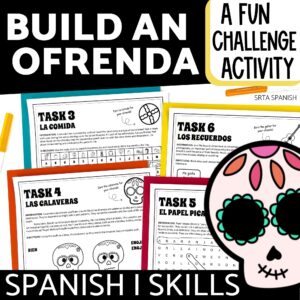
El Día de los Muertos Activities Day of the Dead Escape Room Spanish Lesson Plan
$4.25 Add to cart -
Sale!
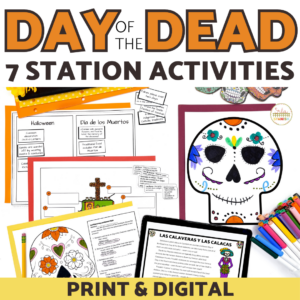
Día de los Muertos Activities for Exploring Day of the Dead
Original price was: $12.59.$8.12Current price is: $8.12. Add to cart -

Día de los Muertos Day of the Dead Digital Activities in English
$3.75 Add to cart -
La Familia Spanish Family Tree Vocabulary Activity Reading Comprehension Passage
$5.25 Add to cart