

Let’s look at 10 ways you can use the scavenger hunt clues from ¡Corre en Círculos! in your Spanish classes! We’re going to talk about this scavenger hunt style game, how to play, and then 9 more ways to re-use the clues from the game to help your students review the topics in different ways.
Watch the video
What is ¡Corre en Círculos! ?
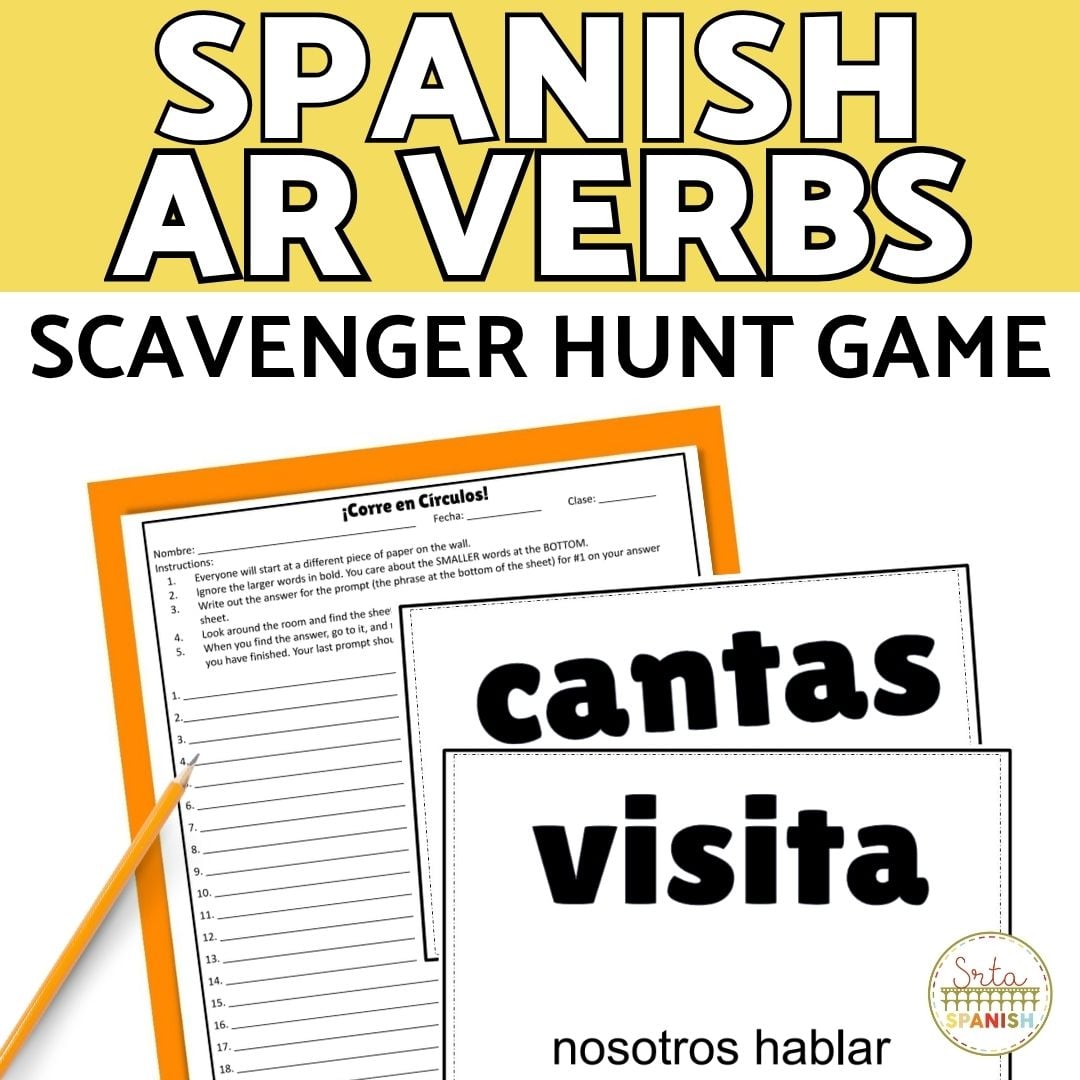
¡Corre en Círculos! is an activity that to review or practice with students. It’s similar to “I Have Who Has” or “Chain Reaction”, but instead you hang the cards up on the wall and students search for their answers around the room! It’s not complicated, but it’s a LOT of fun.
How does ¡Corre en Círculos! work?
Here’s how to play this game:
- Students can start at any page around the room.
- Read a prompt at the bottom of a starting page.
- Record their answer to the prompt.
- Find their answer on the top of a new page.
- Look at the prompt on the bottom of the new page, record their answer, then find the next sheet.
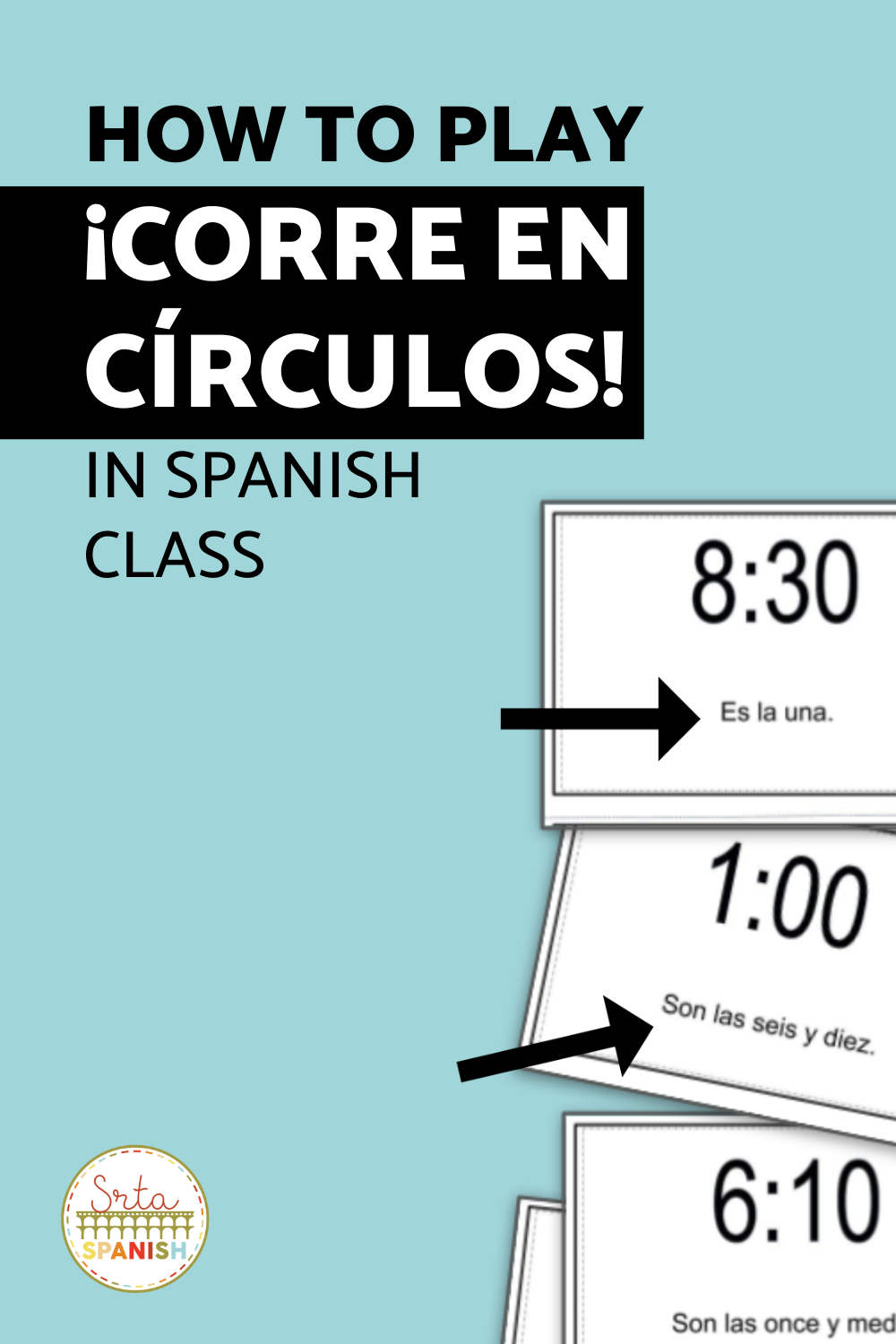
This continues until students find the prompt that leads them back to where they started (thus Círculo).
The picture below might help to understand! In this example, students look at an image showing what the weather is like, then describe the image in a sentence.
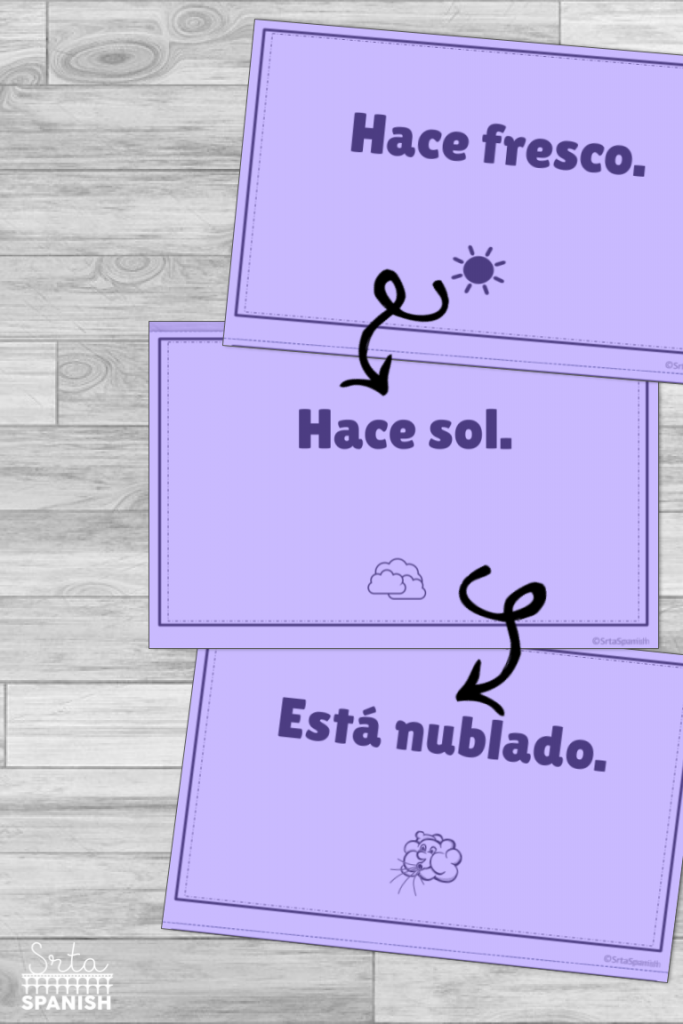
Students continue beyond what is shown in the visual, until they reach the picture that illustrates “Hace fresco.” That would lead them back to the beginning, completing the activity. It works like a scavenger hunt around the room as they read the clues and go from card to card!
How do you introduce it to students?
Sometimes reading a description of a game isn’t helpful, but it all clicks when you see it in action. Here’s a quick video to show how I like to walk students through how to play for the first time:
I hope that helps clarify! If you have any questions, please don’t hesitate to drop a comment and ask!
How long does it take?
This depends a little bit on a few things: how well do your students know the material? are you doing the game as a review at the end of a unit, or for practice at the beginning? are they careful or do they rush & make mistakes – causing them to have to retrace their steps or start over?
In general, I usually plan for about 35-40 minutes of my class period. Once they finish the activity, they turn in their answer sheet & pick up a fast finisher. I like to do something related to the skill, whether it’s a mini puzzle variation of the Corre set they were just working with, or a maze game for them to work on!
How else can you play?
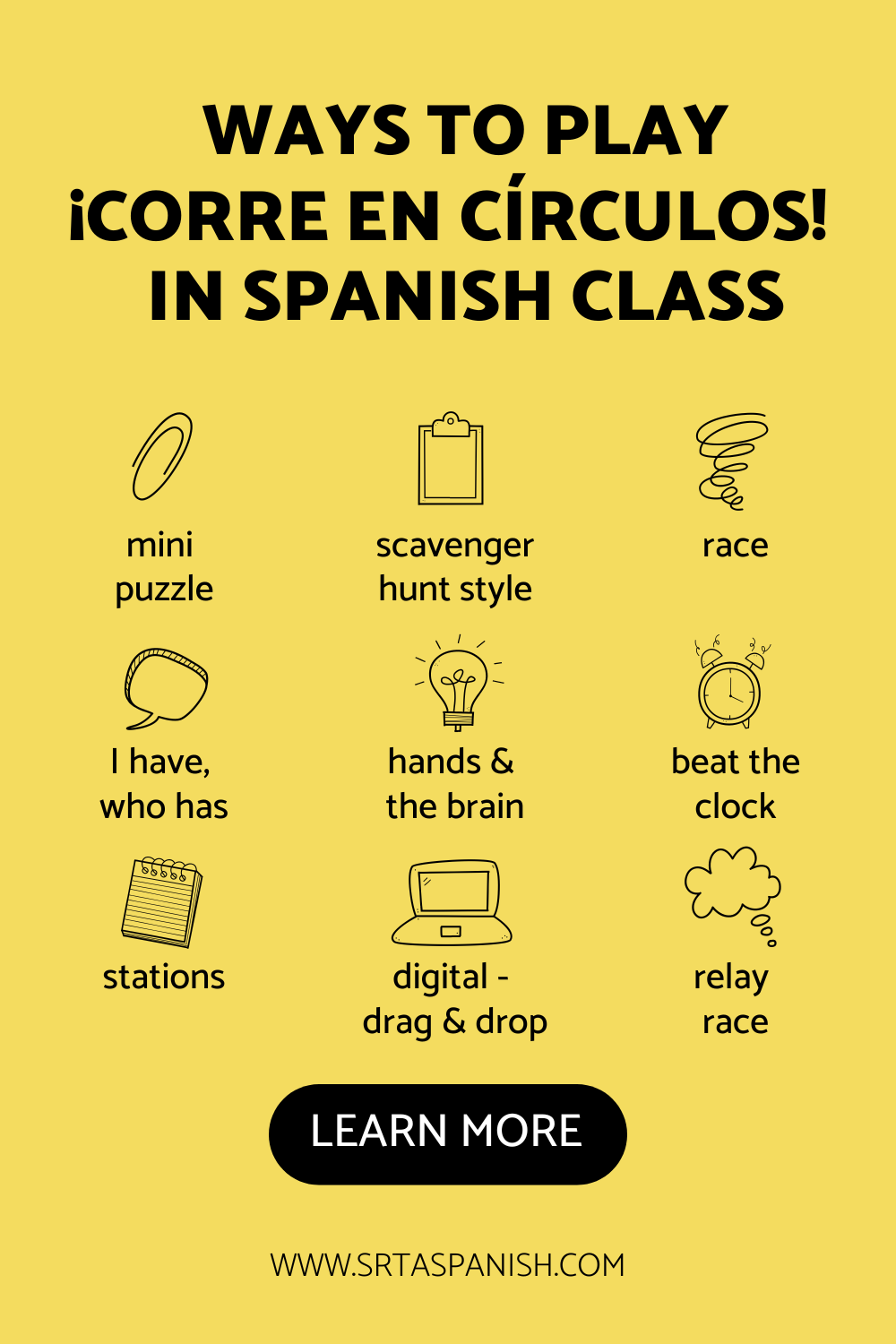
As much as I LOVE this game, we can’t do it the same way every single chapter. The kids wouldn’t want to play anymore! Here’s 9 more ways we can mix this up:
- Mini puzzle – Students play this mini version on their desks to complete the circle. Here’s a tutorial on how to print them mini, in case you need it!
- I have who has – Students call out the cards they have in this listen & response game
- Stations – Use a smaller set as part of stations
- Race – Self-explanatory, no? Give them all a paper to start at, say GO! Project a big timer for added drama.
- Mini race- go fast, but use the mini puzzles. If you want, they can work in pairs!
- Digital – Drag & drop version with Google Slides
- Relay – Split up students into teams, they race back and forth to gather all the cards and complete the puzzle
- Beat the clock – Like mini race, but the time gets shorter & shorter
- Hands and the Brain – Students work in pairs to complete the puzzle. One student can touch the pieces, but can only do so when their partner instructs them to. Teamwork at its finest!
How do you make the puzzles mini?
Several of the variations above work best with smaller pieces of the puzzle. It’s super easy to print them whatever size you’d like! Several of the variations above work best with smaller pieces of the puzzle, and it’s super easy to print them whatever size you’d like. Here’s a tutorial for you. Before printing full sets, try one page first to make sure everything is still readable. Two or four per page usually works great for desk activities and partner games. If you plan to reuse them, print on cardstock and laminate for durability, especially if you’re using them in stations or relay-style games. I like to store mine in small envelopes or bags with labels so they’re easy to grab and go. You can even color code by topic or unit to keep things extra organized. Mini puzzles are perfect for fast finishers, warm-ups, or quick review, and having them ready saves time while keeping students engaged and active.
Here’s a tutorial for you:
If you would rather print from Google Slides than a PDF reader software like Adobe, here is a different tutorial video for that!
Download a set to play!
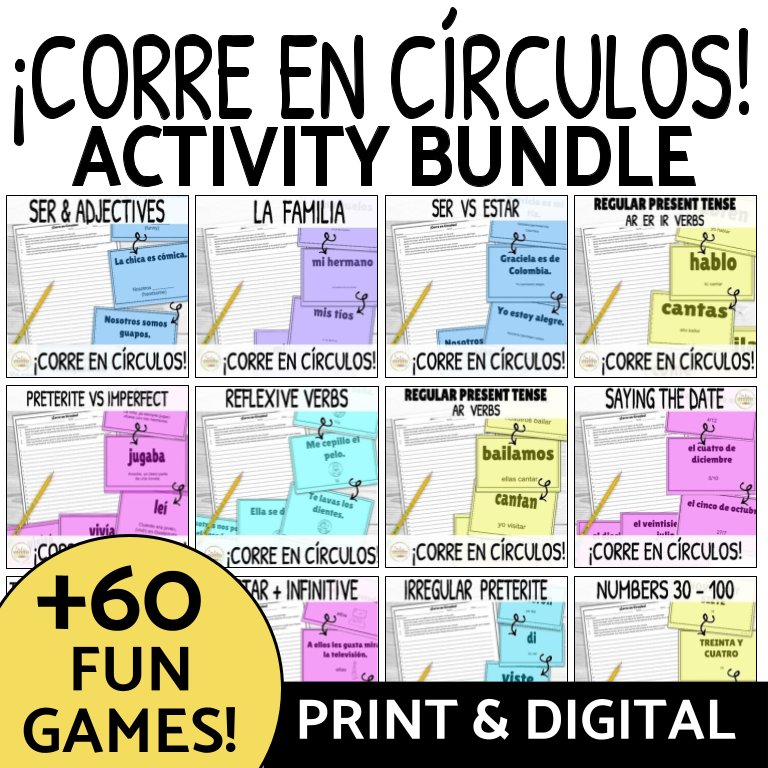
If you would like to download a set with the student answer sheet, answer key, and all the questions and prompts made for you, here are ALL of my ¡Corre en Círculos! activity sets!
Secret Clue Twist for ¡Corre en Círculos!
This version of the game adds just a little sprinkle of mystery that totally hooks your students. Before class, pick a few cards and add a small sticker or symbol on the back. Don’t say a word about it just let them play the game as usual. Once students complete the full circle and end up back at their starting point, they flip over their final card.
If their card has a sticker, they get a small prize or a class reward. Maybe it’s a bonus point, choosing the next music break song, or being your special classroom helper. Whatever you decide, the mystery is half the fun!
I’ve even had students ask if we could play again just so they can “try to find the sticker one.” This version is great when your class needs a little boost of energy but you still want them reviewing and moving with purpose.
Team Mode – Collaborative and Competitive
If your students have played ¡Corre en Círculos! a few times, try running it in teams. Each group starts at a different card and has to stay together throughout the activity. This means they have to agree on answers, double-check each other’s work, and collaborate as they move through the clues.
If the group ends up at the wrong card, they have to backtrack together. It’s a super fun way to build teamwork and hold students accountable. I love how it encourages conversation in Spanish and gets everyone participating.
Sometimes I turn this into a timed challenge or give a prize to the first group to complete the circle correctly. It brings out just the right amount of competition while keeping it light and positive.
Try this version when you want high energy, lots of language use, and all eyes on the prize!


-
El Día de los Muertos Activities Day of the Dead Escape Room Spanish Lesson Plan
$4.25 Add to cart -
Sale!
Día de los Muertos Activities for Exploring Day of the Dead
Original price was: $12.59.$8.12Current price is: $8.12. Add to cart -
Día de los Muertos Day of the Dead Digital Activities in English
$3.75 Add to cart -
La Familia Spanish Family Tree Vocabulary Activity Reading Comprehension Passage
$5.25 Add to cart
One Response
I played this today with my Grade 6,7 & 8 classes, and they were so engaged! Some students were genuinely challenged by the words (Even though they seemed the most obvious to me!) and other students who found the words easy, still enjoyed all the movement!