Are you working on your lesson plans for the verb gustar? If your students have already mastered other present tense Spanish verbs, gustar can be a little tricky! Let’s talk about how you can introduce and reinforce the verb gustar through different activities and resources for your middle school and high school Spanish courses. Check out these gustar practice worksheets!

Watch the Unit Plan Video
Spanish 1 Lesson Plans for Gustar Likes & Dislikes Unit Plan Outline
- Days 1 & 2 Introduce the Verb Gustar
- Days 3 & 4 Read “Las Cosas Favoritas de Melinda” Printable Short Story & Complete Activities
- Day 5 Gustar y los pasatiempos gallery walk
- Day 6 Gustar Conversation Cards Warm up & Corre en Círculos Review Game
- Day 7 Gustar Scrambled Sentences Activity
- Day 8 Dictation Activity & Free Writing Assessment
How to Introduce the Verb Gustar
For days 1 and 2 of the unit, we will introduce the verb gustar. As I mentioned earlier, if you throw gustar on the board and demonstrate how to conjugate it, they’ll likely get confused. I like to use this one in context, much like the first day of school activity I share here! Check out the video for a walkthrough:
While the video demonstrates the activity with an emphasis on “jugar” and different sports, you can easily apply a similar strategy for a helpful introductory exercise. Have students take a blank sheet of paper, and fold it in half. On one side, have them illustrate things they like. On the other, have them illustrate things they dislike. You can also have them draw a few things they like and dislike (say, three of each) on one side for a different conversation set up!
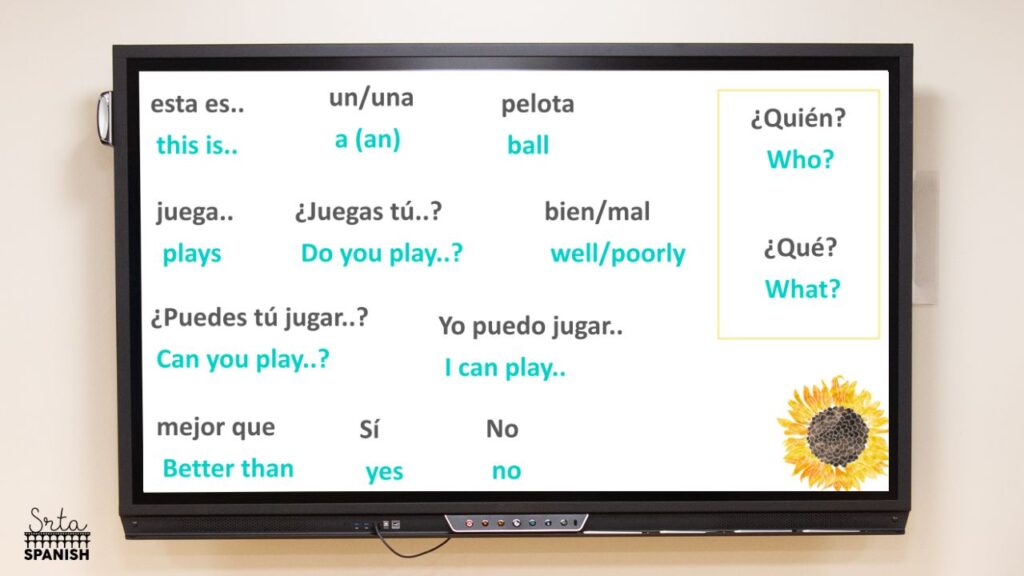
Then, using a slide with scaffolding, ask your Spanish students about their likes and dislikes. I recommend using a combination of PQA, circling, and triangling. It’s not as scary as it sounds if you’re new to comprehensible input!

The gist is, your students are going to provide the information, instead of using a slide show to introduce placement of subject pronouns, the correct indirect object pronoun, and so on. By simply asking, ¿Te gusta..? and using illustrations from the papers they’ve illustrated, you’ll get a lot of repetitions in!
Start with any cognates you might spy – sports, activities, food – and don’t be afraid to play some charades and use the board to write the English translation! Remember, if your goal is spending 90% of class time in the target language, you want that 90% time to be comprehensible to your students – not confusing mush!

Click here to learn more about 90% time in the target language.
As you work through the card talk activity and students are getting the hang of answering, “Sí” or “No” when you ask them, “¿Te gusta..”, you can start to work in the third person! This is called triangling. After you’ve established that Student A likes pizza, you can ask the class as a whole, “¿A Student A le gusta la pizza?” and the class can respond as a whole chorus, “Sí”. You don’t need them to answer in a whole sentence, but you can reinforce it by nodding and saying, “Sí, a Student A le gusta la pizza.”
Keep building on this activity! When the class feels ready, you can also move to an either or question such as, “¿Te gusta la pizza o la hamburguesa?”, or asking them which classmate prefers a certain activity. As you work in and keep practicing, you can also model other forms of gustar, like saying, “Me gustan los libros” to illustrate what happens to gustar with a plural noun.
If you have a student who needs a little differentiation in terms of the levels of questioning, you can ask them open-ended questions like, ¿Qué te gusta hacer?” or “¿Qué te gusta comer?” Remember – scaffolding is always key to support them! Use those visuals you have in your classroom for support, write on the whiteboard, and lean on the slide you have up as well. Check out an example slide set up in my post here.

Click here to see the must have visuals I recommend hanging in your classroom!
As you wrap up the card talk activity, I like to finish the day with a write and discuss. This is exactly what it sounds like! You write in Spanish, while you and the students discuss what happened in class. When you finish, you should have a brief paragraph that turns into a short reading you can use for the following class! If you have multiple class periods, you can mix and match the short readings, or turn them into a handout alongside your Gustar Practice Worksheets later on in the unit. These worksheets are perfect for reinforcing the vocabulary and structures from the discussion, so pairing write and discuss with Gustar Practice Worksheets helps students practice in multiple ways.
On day 2, use that write and discuss reading with any of your favorite reading activities. Here’s a list of my favorites for you to choose from if you need some ideas!

Gustar Practice Worksheets
Gustar Reading Texts and Short Stories
If you’re not ready for trying write and discuss, or you’ve used up that reading and you need more input for your students, let’s look at some more short stories and reading passages you can use in your classes! These activities work perfectly alongside your Gustar Practice Worksheets to give students more comprehensible input and variety.
Let’s look at a printable short story set you can use with your students and how you can set it up for several days of activities! This is what I would recommend for use on days 3 and 4 of your unit:
Gustar Reading Short Story and Activities

This comprehensible Spanish reading activity is a great way to practice gustar and hobbies in Spanish with your students and provide a great source of Spanish CI for your novices! This resource includes a short reading about a girl spending Saturday doing her favorite things in comprehensible language. The reading includes vocabulary supports at the bottom of the page to help your students be successful. Here’s what is included in this Spanish worksheet set:
- Two Versions of the Story:
- one version with vocabulary support
- one version without vocabulary support, but with space for students to add notes as needed
- 3 student handouts pages for students to do to check for comprehension
- First page: True/false, fill in the blank, and matching
- Second page: Complete the sentence, order the events, and unscramble the sentence
- Third page: Comprehension questions and story re-write
- Answer Key for activity pages so students can check the correct answers or for easy grading
On days 3 and 4 of your gustar unit, start by telling the story. Write words or phrases that they may need some more help with on the white board. The word bank on the bottom of the story might give you some ideas! I would also circle a bit as you tell the story. Check out my post here for some tips on how to circle!

Remember to take your time with it and make sure your students understand as you tell the story! At the end of the second day, choose one or two of the activity pages for students to work with. I recommend pages 1 and 2 from your Gustar Practice Worksheets set, as they’re great for reinforcing comprehension in a simple, structured way.
Gustar y los Pasatiempos Gallery Walk

I only have this in the sample outline for one day, but goodness, you could really dig in with these materials! Here’s everything included in the gustar y los pasatiempos gallery walk:
- 14 short readings with footnotes
- 14 short readings without footnotes
- Scavenger hunt printable worksheet in Spanish
- Scavenger hunt printable worksheet in English
- Answer key for scavenger hunt in Spanish
- Answer key for scavenger hunt in English
- Additional writing activity with Spanish instructions
- Additional writing activity with English instructions
- Read and re-write activity about the student’s hobbies
- Cover and “final page” to turn the readings into a book for your classroom library
- Digital version of the readings, scavenger hunts, and writing activities for Google Slides (43 Slides) on Google Drive
- Additional reading comprehension activity for each of the readings using Google Slides OR Boom Cards – each of the 14 readings has 3 comprehension questions
- Teacher’s notes for use

If you find as you’re working through the unit that students need more input with the use of the verb gustar, you can really lean into these readings or pair them with your Gustar Practice Worksheets for extra support. If you can tell from their work in class that they have a good handle on it, you can just use the readings in a traditional gallery walk. Here’s a quick walkthrough:
- Print the short reading passages, cut the pages in half, and hang them
- Give students the scavenger hunt printable worksheet in Spanish or in English
- Students walk around the room and read the passages, using the information to complete their assignment sheet
- As they finish, students pick up the independent practice for a fast finisher or sponge activity

If you want to see more about how to use a gallery walk in your classes, check out my blog post here for a more detailed explanation!
For the fast finisher, there are a lot of options you could choose from. If you used just one of the activity pages from the “Las Cosas Favoritas de Melinda” Printable Short Story, you could do the second page. You could also use the “Mis Pasatiempos” read and re-write activity about the student’s hobbies included in the gallery walk download!

I have also used the digital version on Google Drive for a fast finisher option for students to get more work with those same readings in a different way. Or, just pick your favorite fast finisher you like to use. I recommend independent work because your students will likely be finishing the gallery walk at different times.

Creative Ways to Use Gustar Practice Worksheets
Ready to make your gustar lessons unforgettable? Gustar practice worksheets aren’t just for quiet seat work—they can be your secret weapon for interactive fun! One of my favorite ways to use these worksheets is to turn them into a partner challenge. Instead of working solo, students pair up and complete sections together, comparing answers as they go. This encourages speaking practice and helps build confidence in a low-pressure setting.
You can also use the worksheets as a warm-up for storytelling. For example, after students complete a short section, have them share what they like or dislike using complete sentences. “A mí me gusta leer, pero no me gusta correr.” Encourage them to add a silly twist like “A mi perro le gusta escuchar música.” These little conversations bring the grammar to life and make students forget they’re even doing grammar practice!
Pro tip: Add a timer to create a mini race. Students love a challenge, and a little competition turns any gustar activity into an instant favorite!
Gustar Conversation Cards
On day 6 of the unit, you can start with a quick warm up activity. After all that input, they are likely ready for a little scaffolded output. Conversation cards are one of my favorite speaking activities! These question cards will help your students start some conversations and practice talking about likes and dislikes in the yo and tú forms (me & te).

There are lots of visual supports included, as well as cognates to help your novice students be successful. You can have students up and walking around in a Quiz-quiz-trade activity, or you can simply have students group up and take turns asking and answering. Both are great options!

As a quick formative assessment, you can also stand at the door and use a card with each student as they walk in. It’s a fast way to get an idea of how your students are understanding the use of singular and plural nouns, different verbs in their infinitive form, and the verb gustar.

Gustar Scavenger Hunt Review Game
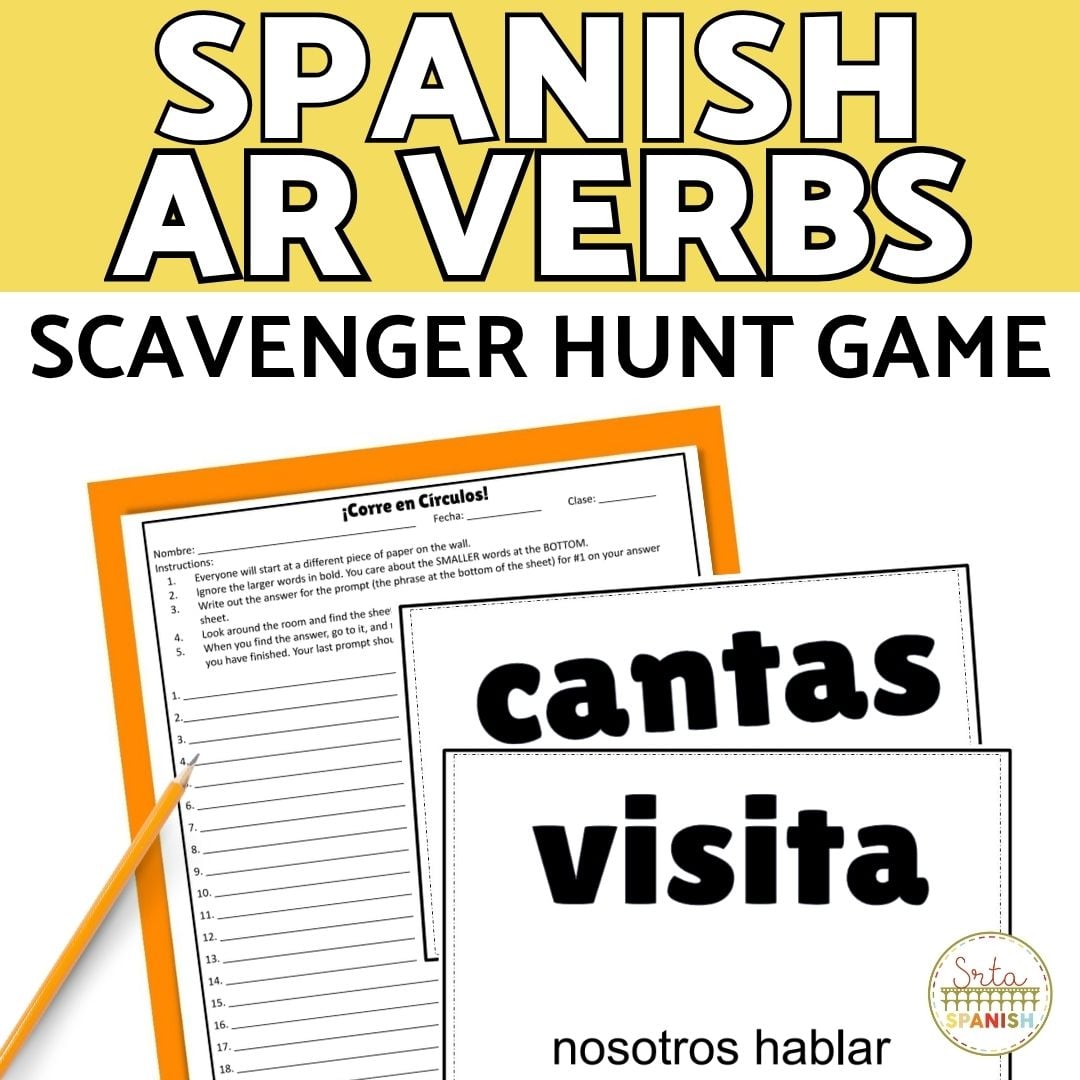
After a quick warm up, students will play the Corre en Círculos review game. This is one of my favorite fun educational games to use and it has a printable version and digital version to choose from. I generally use the printable version in class and save the digital version for absent students.
Here’s how to introduce the game to your students:
This scavenger hunt offers two formats: one with the prompt structured as “subject/verb” (for example, “yo/estudiar”), and another where the prompts are structured with the subject and clipart. You choose what is best for your students!

Verbs Included:
- andar en bicicleta
- bailar
- beber
- cantar
- comer
- correr
- escuchar
- escribir
- estudiar
- leer
- mirar
- nadar
- trabajar
- tocar
- viajar
This game also includes more forms of the verb gustar, so they’ll work with answers that include more than just the singular Spanish pronoun and perspectives. Sometimes I give students a quick explanation text or pop up on the white board to remind them how of the full conjugation of gustar. For example, I’ll write a prompt, “usted/viajar” and show them an answer, “A ud le gusta viajar” and show them a traditional verb conjugation chart. Here’s a few examples for you!


This portion of the lesson is really very short. Think 5-7 minutes!
After that pop up, students will get rolling with the scavenger hunt. As they finish, you can have students pair up and chat using the conversation cards again!
Gustar Scrambled Sentences
Scrambled sentences are a great way to get your students thinking and talking about the language collaboratively! Groups or partners work together to reassembled the scrambled sentence while working on the verb forms. This set of activities includes instructions on how to use this game, and a few variations for you as well. One variation is a quick review that will take about 15 minutes, the other version can take up to 40 minutes with in-depth critical thinking about syntax and word order!

There are also student answer sheets included, as well as a version that comes pre-scrambled, in case you’d prefer to have your students cut out the words to reduce your prep time!
Add Digital Flair to Your Gustar Activities
Want to keep students engaged even when they’re not in class? Take those same gustar practice worksheets and make them digital. Upload the activities to Google Slides or an interactive platform, so students can drag, drop, and type their answers. This is especially helpful for homework or distance learning days.
Another fun idea is to combine your gustar worksheets with online polls. After practicing in class, launch a quick poll like, “¿Te gusta el helado o el pastel?” Display the results in real-time and discuss as a group. Students love seeing the class’s likes and dislikes in a colorful chart!
Adding a tech twist not only makes gustar practice more engaging but also reinforces the vocabulary through different modalities. Plus, it saves you time on grading because many digital tools can auto-check answers.
So whether you keep it old school with printed gustar worksheets or go high-tech, remember the goal: get students talking, laughing, and learning while mastering one of the most useful verbs in Spanish.
Dictation Activity
Dictation in Spanish class is a great way to practice listening comprehension and writing skills. You can choose to place an emphasis on spelling if you would like and encourage students to spell as accurately as possible to help them pay close attention to pronunciation. If you’d like, you can use this dictation activity for your unit wrap up and assessment!

This set of dictation activities include:
- Teacher’s Guide & Notes
- 12 Running Dictation Slips – print & hang
- Running Dictation Sheets – with or without accuracy check
- Classic Dictation – record and translate
- Illustration Sheet
- Read and Draw page
- Listen, Write, and Draw
- Extension Activity – students write their own and trade with a partner
- Audio file (12 sentences, each repeated 2x)
*Please note, the audio is not recorded by a native speaker - Script

For the formative assessment, I would use the Listen, Write, and Draw format of the activities and play the audio file for your class two or three times. You can finish it up by having students do a free write talking about their own likes and dislikes, too!
Verb Gustar Practice Worksheets for Spanish Class
I hope this sample outline for your Spanish 1 lesson plans has been helpful for you! Hopefully it shows how you can take these gustar practice worksheets and activities and use them with your Spanish students to speak about likes and dislikes in their lives.
Download the Bundle of Activities

Save this post for later!

More like this..
Spanish 1 lesson plans for school supplies and classes Spanish vocabulary
El tiempo worksheets & activities


-
El Día de los Muertos Activities Day of the Dead Escape Room Spanish Lesson Plan
$4.25 Add to cart -
Sale!
Día de los Muertos Activities for Exploring Day of the Dead
Original price was: $12.59.$8.12Current price is: $8.12. Add to cart -
Día de los Muertos Day of the Dead Digital Activities in English
$3.75 Add to cart -
La Familia Spanish Family Tree Vocabulary Activity Reading Comprehension Passage
$5.25 Add to cart