If you’re teaching Spanish 1, you likely have a goal of helping students learn Spanish adjectives to describe people. Whether you’re talking personality traits or physical appearance, descriptive adjectives are a great place to spend some time with your Spanish lessons! Here is a 10 day unit plan to teach the verb ser, subject pronouns, and Spanish adjectives to describe people to your middle and high school students!
Watch the Video
Parts of Speech
Before we get into the lesson, let’s chat about parts of speech. I hate to be all “back in my day..”, but it seems like it’s pretty common for students to not know the terms for parts of speech like nouns, subject pronouns, or even adjectives. So, when you start thinking about Spanish nouns and adjectives, it can get tricky if you’re going to get technical. Instead, let’s use grammar in context and give them ways to understand the information like feminine or masculine nouns and how Spanish adjectives change to match the masculine or feminine form. Even though those are key rules, there’s more than one way to teach them!
Spanish Descriptive Adjectives
Spanish Personality Adjectives
Here’s a short list of vocabulary you might choose to include when teaching your students to describe people’s personality traits:
aburrido
artístico
cómico
creativo
divertido
estudioso
fantástica
inteligente
interesante
paciente
perezoso
serio
simpático
trabajador
Spanish Adjectives for Physical Attributes
Here’s a short list of Spanish adjectives you might choose to include when teaching your students to describe physical characteristics:
atlético
baja
barba
bigote
bonito
castaño
delgada/o
fuerte
gafas
gordo
grande
guapo
moreno
negro
ojos castaños
pelirrojo
pelo corto
pelo gris
pelo largo
pelo negro
pelo rizado
pelo rubio
pequeño
rubio
Physical descriptions can be overwhelming at first for students to find the right words because we’re all so different! Green eyes, blue eyes, brown hair, black hair – there are so many different adjectives and body parts it can be a lot. It’s okay to take your time with personality and physical features because you want students to feel seen and recognized in the vocabulary you present to them. Include those useful adjectives for them to describe themselves and their loved ones!
How to Teach Spanish Adjectives to Describe People
Introduce Subject Pronouns
Remember when we talked about parts of speech? Let’s start this unit by introducing subject pronouns and helping them understand a little about what they are and how they work. Yes, even though you teach the Spanish language, sometimes this means we wind up teaching English skills! This doesn’t need to be a comprehensive guide, just a good way to introduce these basic grammar structures.
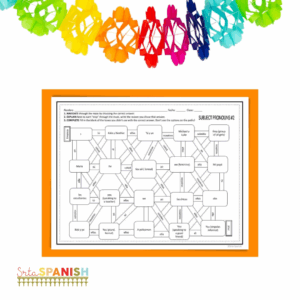
After introducing them, play a game to reinforce the concept of a pronoun taking the place of a noun. I love mini whiteboards for this, or you can play Lo Tengo!
Finally, wrap up the lesson with a fill in the blank activity and a maze worksheet. Maze worksheets are one of my favorite ways to have students practice independently!

Subject Pronoun Stations
Fun fact about me: I love stations! They’re a great way for students to practice speaking, reading, writing, and listening skills all in one class period, without a lot of stress. They’re able to work in small groups doing manageable tasks, and there’s movement involved. Win, win, win!

After a quick review from the previous day’s class, students will work on 4 subject pronoun stations in a small group of people. The stations include:
- Reading – students complete a chart with the subject pronouns, then find their way through the maze to show comprehension
- Writing – students play a mini Corre en Círculos scavenger hunt game to connect illustrations as they record the correct subject pronoun for each picture
- Speaking – students roll and say the subject pronoun as they play Bump! with a partner or small group
- Listening – students listen to 3 listening activities that focus on recognizing what they hear.
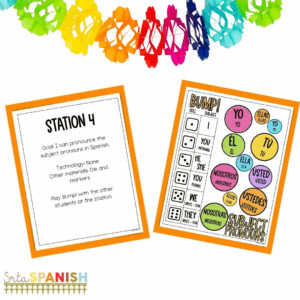
Stations are a great way to work on language skills. While I love having students work on Spanish conversations in their small groups, the speaking activity in this set has students play a game to roll and say the words.
At the end of class, students will wrap up with Boom Cards. I love these because they instantly give feedback to students in a way a Spanish textbook never could.

General Rules on Spanish Adjective Agreement
When students are learning how to use adjectives, they might confuse them with English adjectives for placement. Plus, the language rules of gender and number agreement can seem confusing at first, so it’s a good idea to make sure students have plenty of exposure to commonly used adjectives in both plural form and singular form, so they see where to place adjectives and how they agree with the nouns.
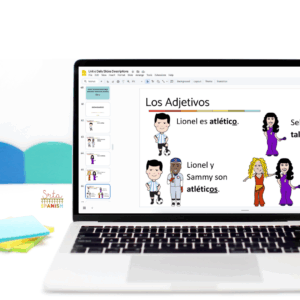
In the next day’s lesson in this unit, you’ll introduce the concept of adjective agreement, then students will play with the language rules using Scrambled Sentences. The twist on this activity is that students put the sentence in order and choose between different Spanish adjectives to match the noun being described. They quickly pick up on noun gender and number while they play this game!

Since students will all finish at different times, I like to have a fast finisher handy! In this case, as students finish they will grab a Read and Draw sheet. They will read sentences about different Spanish speakers and draw to show the physical traits to show comprehension!

Spanish Reading Activities for Descriptive Adjectives
Day 4 of this unit is one of my all time favorite lessons – EVER. It’s a gallery walk that introduces students to new people (or people they know!) from various Spanish-speaking countries while reinforcing character traits and novice vocabulary in a scaffolded, supported way.
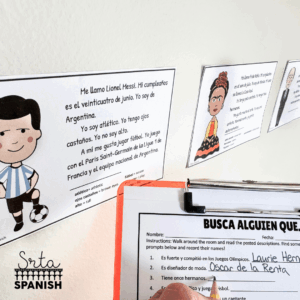
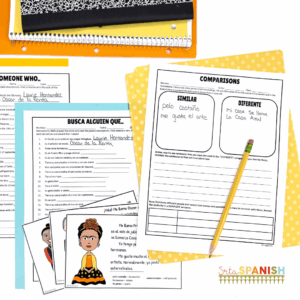
Students walk around the room, reading the passages and don’t even realize how much Spanish they’re getting as they work through the “Find someone who..” sheet. When they finish, they’ll wrap up the day by making comparisons between themselves and one of the people in the readings.
Reviewing Spanish Adjectives to Describe People
For the next two lessons, we’ll encourage students to bring all the activities we’ve done so far together with some fun games! First, they’ll start off with a grid puzzle. In a grid puzzle, students line up the sides of the squares to match until they complete the grid.

After the puzzle for warm up, students will play guess who.This is such a great game for adjectives! If you have a set of the board games for your class, that’s great, but I love the game board I made to go with this unit! Students see a board of famous Hispanics and the flag of the Spanish-speaking country they come from. They use the scaffolding sheet to take turns trying to guess the person chosen. You can always start playing as a whole class so you can model it for students before splitting them up into pairs or small groups.
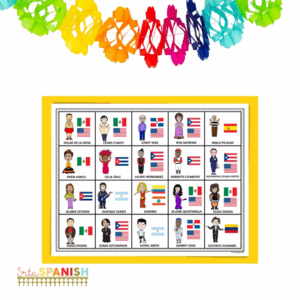
Now that students have been doing some speaking with each other, we’ll move onto an individual listening activity. This Listen, Write, and Draw is a great way for students to focus on the language they hear, and show comprehension through illustration.

Finally, they’ll end the day with the set of Boom Cards to practice ser, tener, and descriptions with the same people from the Guess Who game for reinforcement!
On the second review day, the class will play Guess Who for warm up. Then, students will get up and move around playing Human Bingo.
The last review game students will play with the language is a version of the Corre en Círculos scavenger hunt game! Students will play a relay race version of the game in teams, hurrying to finish the puzzle first!

Spanish Adjectives Project for Spanish Class
To wrap up this unit, students will complete a research project and presentation. It’s a great tie in to Hispanic Heritage Month while they describe the person they research!
This Wax Museum Project will help your students create a biography research report on a famous person of Hispanic Heritage. The finished project is a Wax Museum event, where students dress up as the person they have learned about and hold a “pose”, like a Wax Museum, until someone walks up to them and presses the “button” near them. Then students give a short speech about that person’s life.
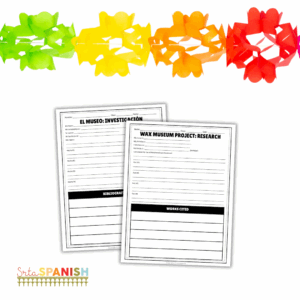
This project can take several days, but you can lengthen or shorten the time frame based on your students’ needs and your pacing guide. Here are the steps:
- Assign someone to research, or students choose
- Students take time to research, using scaffolded handouts to guide them
- Students write their rough drafts
- Final drafts and speeches are written
- Props and/or costumes are brought in
- Visitors come to your Wax Museum!
If you are doing this unit during Hispanic Heritage Month, this is a great way to connect it to your student body in a school wide celebration! You can also invite guardians and parents, other classes, or simply split the class in two to have them present to each other!

Download the Unit Plans and Activities
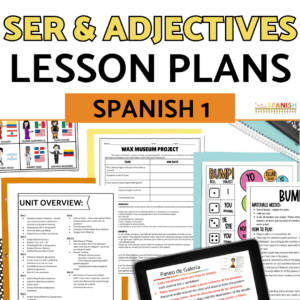
I hope this unit outline has been helpful for you! If you would like to download the Slides and activities I have ready for you to use, click here to grab them all! This unit includes:
- Teacher Guide
- 10 Days of Lessons & Daily Slides
- 200+ pages
- Comprehensible Reading Passages
- 5 Engaging Games
- 3 Audio & Video Files
- Unit Assessment
- Answer Keys
- Print & Digital Formats
Frequently Asked Questions:
- How long is this unit?
This unit is designed for 10 45-50 minute class periods. - Is this editable?
The daily Google Slides for the teacher to project are editable (except for images where they are locked per terms of use by the artists) and the students are able to edit the digital activities to respond. The worksheets and activities themselves are not editable. - What technology is needed?
A projector to display the slides. Otherwise, all activities and resources can be printed. The digital student activities are hosted on Google Slides, Google Forms, and Boom Cards. Please verify that your school allows access to these, or plan on using the printable versions. Thanks! - What vocabulary is included?
Please see the lists at the top of this blog post.
Save this post for later!
Related Blog Posts:


-
El Día de los Muertos Activities Day of the Dead Escape Room Spanish Lesson Plan
$4.25 Add to cart -
Sale!
Día de los Muertos Activities for Exploring Day of the Dead
Original price was: $12.59.$8.12Current price is: $8.12. Add to cart -

Día de los Muertos Day of the Dead Digital Activities in English
$3.75 Add to cart -
La Familia Spanish Family Tree Vocabulary Activity Reading Comprehension Passage
$5.25 Add to cart